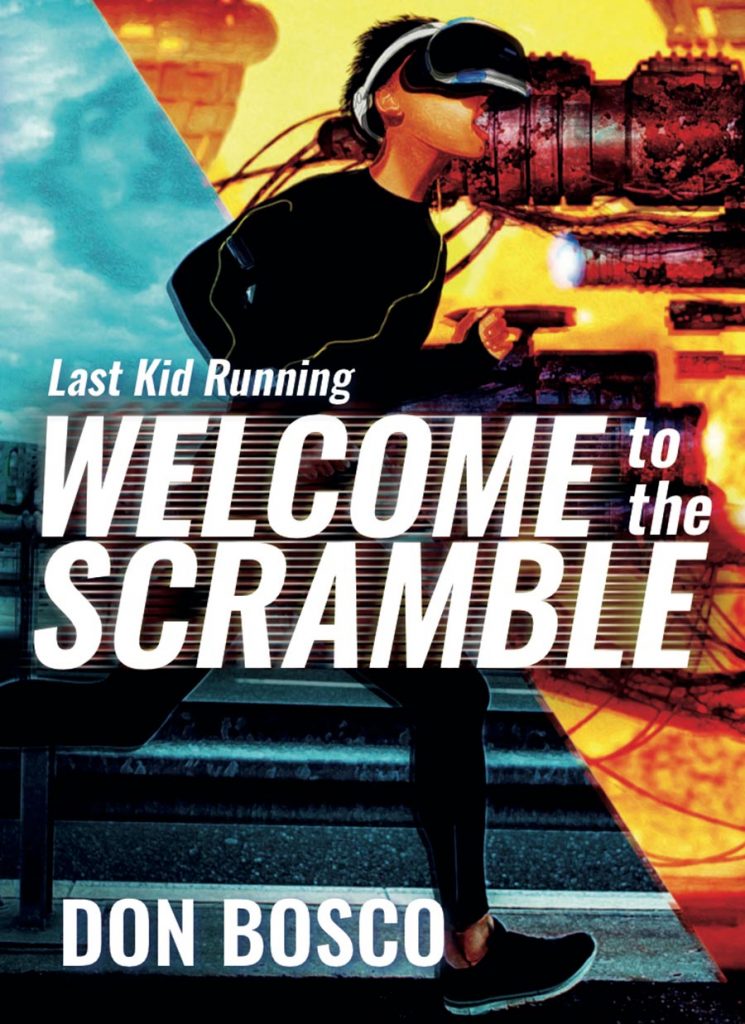
GBN has been excited to be in touch with Don Bosco, an award-winning writer and publisher of thrilling fiction for teens and children, and founder of the publishing studio Super Cool Books. In 2019, Don published his latest gamebook: Last Kid Running, Welcome to the Scramble. Here is its synopsis!
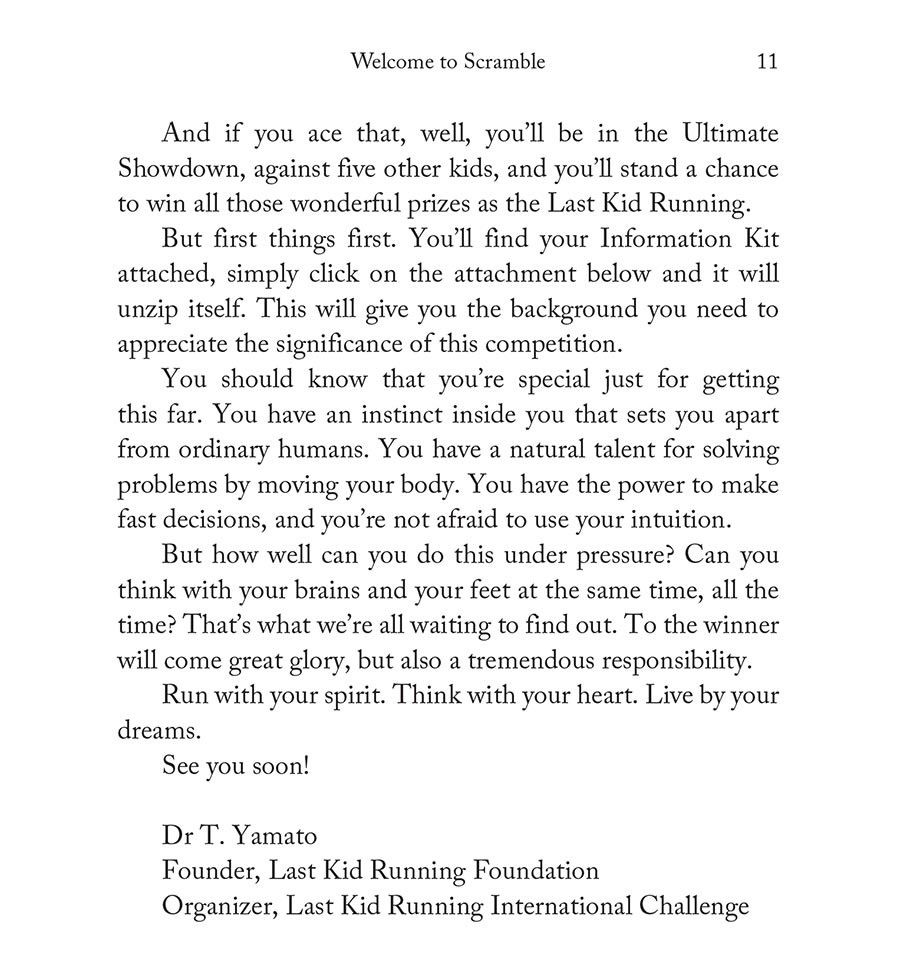
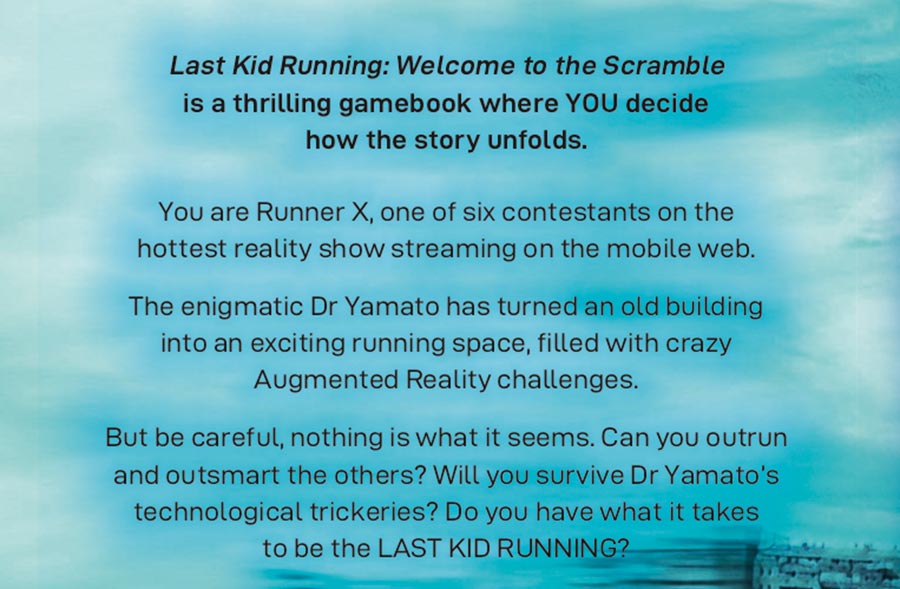
LAST KID RUNNING is a thrilling gamebook where YOU decide how the story unfolds. You are Runner X, one of six contestants on the hottest reality show streaming on the mobile web. The enigmatic Dr Yamato has turned an old building into an exciting running space, filled with crazy Augmented Reality challenges. But be careful, nothing is what it seems.
Can you outrun and outsmart the others? Will you survive Dr Yamato’s technological trickeries? Do you have what it takes to be the LAST KID RUNNING? Gosh, read and find out!
Intrigued? Well, so were we; so much so that GBN leapt at the chance to interview the author: let’s see what he had to say!
Last Kid Running looks like a fun series, full of action, decisions and neat technology. What was your inspiration for writing these books, and what type of reader are you hoping to engage?
Answer: My two sons love to read, but they don’t enjoy the same kind of stories, so they seldom discuss books. When it comes to games, though, they really connect. They share strategies, they watch each other play, and where it’s possible they even play together. So about three years back I decided to try making gamebooks with them, just to have fun together. We created our first gamebook in Twine, that was called The Secret of the Chatter Blocks, and it’s now a self-published illustrated paperback. It’s for younger readers, around 8 to 10 years old, and it’s set in a city that’s like Silicon Valley but dedicated to the business of toys and games.
After that I had a chance to pitch a gamebook series to Penguin Random House, and it was to be a middle grade series, 10 to 12 years old, which meant that the worldbuilding had to be much richer. I remembered how I took my two sons to visit a friend who had created a virtual reality rollercoaster, with wind machines and all that, and how we were all awed by the immersive experience. So I came up with this idea of a running game, kind of like Parkour, but competitive, and there are VR challenges that you have to clear, and it’s all organised by an eccentric billionaire inventor named Dr Yamato.
Just thinking about it back then, it seemed to me that a gamebook based on an actual game would allow me to really foreground the action, the thrills and the sense of competition and progress. Capture the whole physical experience. And so that became the core of the concept.
I’m writing for kids who haven’t had much experience with gamebooks, or text based adventures, and so this could be the first gamebook that they get to read, and I took that responsibility very seriously. I really hope that after reading any of my Last Kid Running books, these young readers will become inspired to make their own gamebooks too. That would be so cool.
What are the key ingredients in these adventures (rivals to beat, puzzles/threats to overcome, etc), and does the series feature multiple ways to be successful?
Answer: As I mentioned, creating a gamebook about a game allowed me to structure the whole experience in quite a convenient and obvious way. For example, each book features a tech-powered running event, which has five levels, with different challenges at each level. You play as RUNNER X, and you have to clear each level before progressing to the next. So it’s like a sequence of five mini-gamebooks, one leading to the next. Also, if you happen to fail at any level, you can just replay that level, instead of starting all over again.
There are six contestants at the start, and the worst-performing one is eliminated after each round, until there is only one survivor, ie, the Last Kid Running, and if this is you, you go on to the next round, in the next book. So the structure of the three-book series matches the structure of the whole competition.
For each level, there are some paths where you succeed and go on to the next level, but without engaging much with the rest of the storyworld. And there are paths where you succeed, but also pick up a lot of information about what else is happening behind the scenes. And even the paths where you don’t succeed will contain interesting bits of information that you can use later on, after you play that level again and succeed. So I tried to make this as fun as possible to replay, where even the bad decisions pay off in some way.
How do you create atmosphere and tension in interactive games? Is your storytelling reliant on specific techniques to continually entertain and challenge the reader?
Answer: My storytelling toolbox is mostly filled with principles from drama, or classical storytelling. A likeable character wants something, but there’s an impossible challenge in the way, so what happens?
As a writer, the atmosphere and tension really comes from maximising these three elements: the strength of this character’s desire, the worthiness of the prize, and how compelling and fascinating and even frustrating the challenges are. So I make lists of ideas around each element, and extrapolate from there.
Tension is really about anticipation. It’s like watching an acrobat who leaps off a pole and starts spinning in the air, we might hold our breath and clench our fists and make a bet with ourselves whether or not the acrobat might land safely, or fall over in a clumsy way, or even get hurt. For storytelling experiences, even in a gamebook, the job is to keep the acrobat spinning in the air across pages, chapters, entire story arcs, and keep the reader gasping and flipping the pages to get to the point where the outcome is revealed and the reader can unclench the fists and breathe easy again. Traditional drama.
Aside from that, since I mainly write for kids, one quick source of entertainment is supporting characters who refuse to go along with the plot, and are determined to satisfy their own whims, and thus derail the story. This is similar to the acrobat idea, but it involves the writer’s ability to spin in the air and land safely, with an unexpected but satisfying closure.
In a recent statement from you regarding kids and interactive fiction, you noted a desire to make reading fun again via interactivity that suited our smartphone-savvy younger generation. Will choices and thrilling storylines truly engage kids already saturated with numerous devices, games and streaming media?
Answer: When we were younger, and first encountered gamebooks, it was such a thrill because there was this license to be an active participant in the story. But urban kids these days are simply over-gamified. Even their online math homework comes with avatars, levels, tokens to win, leaderboards, and so on. Everything from health education to citizen education, excessively gamified. So kids have become wary of token gamification strategies, they don’t associate this with fun anymore.
As my starting point, I really tried to devise a whole variety of ways to subvert their expectations. For example, instead of just having choices that relate to game mechanics, or player progress, in some cases the choices are about rather peripheral observations, which makes it funny and gives it an unpredictable “improv comedy” experience.
Also, if you’ve spent time with kids, you’ll see that many aren’t really “mission-oriented”, they are happy to be distracted and to distract others. They just love it when someone interrupts with a joke or a funny face or some kind of lateral thinking. And I’ve tried to work this into the gamebook too. I won’t give specific details, because spoilers, but I think that’s one way to earn attention from kids who are glued to gadgets, really surprise them and keep surprising them at each turn.
Additionally, you’re hoping that kids might develop a passion for STEM (Science, Technology, Engineering & Mathematics) via the Last Kid Running series, as it features many cutting-edge technologies. How important is this aspect to you, and is the issue even more urgent due to the predicted disruption in the workplace due to new technologies replacing jobs, and a greater need for tech smart employees?
Answer: STEM is important, but what science fiction is good at is dramatising how technology can take a wrong turn, for better or worse, and that’s what I like to explore. Yes, I feature a lot of cutting edge tech in the series, from VR to AR and AI and robotics and all that, but it’s also often been modified to do something peculiar, or sometimes it’s even childish but in a heartwarming way, sort of like a Roald Dahl twist.
So rather than helping to prepare tech-smart employees, the mood is more like if in the future you see some fancy tech that’s creating unhappiness, don’t be scared, maybe you could take it apart and have it reprogrammed.
As the series doesn’t feature detailed game mechanics, and isn’t illustrated, do you have any plans for future projects that would incorporate stats, dice rolling etc, plus include artwork?
Answer: Yes indeed! But I am also incredibly overwhelmed. I have drawn up some interesting mechanics in my notebooks, that I can’t wait to try. But currently I find it really hard to merge this with my storytelling approach, which is really about entertaining readers 8 to 12 years old. I have a few prototypes underway, but I feel they need more work. So it’s very much stuff in progress.
Peter Agapov, who has been active in the gamebook community for a while, has been very helpful in helping me learn more about gamebook mechanics, and he really took the time to help me understand its role in the gamebook experience. Thanks again, Peter! I also recently became a member of the Gamebook Authors Guild, a private group of talented gamebook creators, and I’m also learning about gamebook mechanics through our discussions.
I actually get “analysis paralysis” when I approach this too much from the “story vs mechanics” angle. What works for me is to treat the gamebook as one long and fun rabbit hole, and I use the story and the mechanics to coax readers through this.
As for artwork, My Secret of the Chatter Blocks gamebook features pixel art illustrations by my son, in a retro game style, and the cover is a voxel art illustration he created. I’m really thrilled about how this turned out and I would like to do more gamebooks in this style. <Link to earlier GBN interview.>
What has Dungeons & Dragons taught you about immersive storytelling and gameplay, and how do you then embody this wisdom into your interactive fiction?
Answer: D&D has been described many ways, but I call it “personality gaming.” The whole game experience is a product of the personalities that gather around the table, particularly the dungeon master’s personality. When my kids were younger, I used to create my own simple dungeon-based RPGs to entertain them, and their favourite bits were when I was clearly winging it as the dungeon master, they would giggle in delight. I really like to recreate this experience in my gamebooks.
A lot of existing gamebooks try to be objective when it comes to the mechanics, and the writer or game master is an invisible presence. That’s great. For my current gamebooks though, I like to make it obvious that there’s a person unfolding the adventure with you, and this person is not a robot, but also here to have fun. So the text takes a conversational tone, it’s rather chatty and quirky. Personality is the platform.
Your first interactive story, the FREE eBookToy Mystery: Secret of the Chatter Blocks, offers an adventure for young readers that introduces them to story games. Did you learn any lessons from this project that influenced your approach to Last Kid Running?
Answer: It used to be a free ebook, but after we put out the illustrated paperback edition earlier this year, I took down the ebook. I’ll put it up again after we add the pixel art illustrations, that will make a big difference in terms of the experience.
From interacting with younger readers, I realised that some of them actually got too anxious or even alarmed with the second person YOU experience, particularly when they got to scenes with conflict or tension. So for Chatter Blocks I created it as a third person experience, the player makes decisions for two young characters who are conducting an investigation. So emotionally there’s a safe distance.
Writing The Secret of the Chatter Blocks helped me get a feel for the kind of gamebook experience that I might enjoy making, and it also helped me get familiar with Twine, which I love. Twine is such an important part of my process. The clickable html file it generates is just great for playtesting, compared to if I had to do playtesting on a Word document.
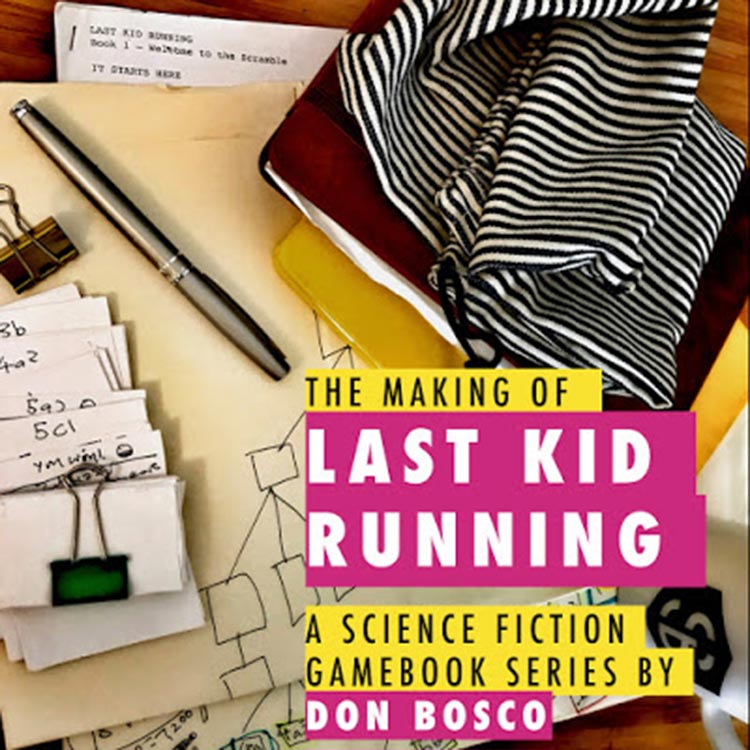
My process since Chatter Blocks has been: sketch ideas and paths and numbered sections on large sheet of Ikea paper, then type up all text in a code folding* editor app using a customised Twee-ish convention that I devised, then manually import the whole thing into Twine for extensive playtesting, then make edits, playtest, repeat, then manually export to Scrivener for manuscript preparation, which includes numbering and shuffling, and then proofread, etc. (*A code folding editor allows you to collapse and expand individual sections, so I can easily expand only the relevant sections and have a quick read).
I’ve also simplified some of my creative process and created a series of blog posts to teach kids how to create their own gamebooks, it’s called the Gamebook Academy, and the posts can be found here: http://www.supercoolbooks.com/2020/05/don-boscos-gamebook-academy-learn-how.html
In September you were a featured speaker at the Second Annual Interactive Fiction Creator’s Conference. What did you talk about in your session, and do you enjoy speaking at events such as this and sharing knowledge?
Answer: Wow, that was a fantastic event, two whole days of online interaction with fellow interactive fiction speakers around the world. It felt like such an epic achievement to gather the tribe like that. Unfortunately, the organiser’s website has been down for some time, they’re called Decision Fiction, and I can’t seem to contact them either, I do hope everything is okay.
One thing I shared that seemed to get some attention, was how I used my branching paths to take the gamebook story in different genre directions. Eg, if you opted to turn left, what unfolded would be a mystery story, and if you turned right, you would find the story unfolding more along science fiction conventions.
This really gives a sense of reward when readers come back and try the level again, because they can feel themselves entering a whole different atmosphere, like they’re in a parallel game.
Another idea I shared was, “A sentence is a soundtrack.” Which means that you can use the sound of your sentences to create a kind of audio accompaniment, like a soundtrack.
Eg, “You take a step forward in the dark, your foot slips, you lose your balance, you can feel yourself falling, and then you hit the floor.” Which feels like a breathless moment where you’re completely out of control.
Compared to, “It’s all dark. You step forward. Your foot slips. You lose your balance. Oof! You hit the floor.” Which feels like you’re focused and still in control. Same ideas, but totally different moods.
Soundtracking your sentences like this can create a layer of atmosphere that adds to the actual information in the words. It also controls the pace of reading. You can use this to speed up or slow down.
I really enjoy getting a chance to talk about how I make gamebooks, simply because it’s a natural part of being a geek and participating in the geek community. We have geeky interests and we make geeky stuff and our idea of fun is to share all this geekiness. I started the Gamebook Academy posts specifically to share knowledge and encourage people to try writing and sharing gamebooks.
Also, my editor at Penguin Random House did mention that they’d like to receive gamebook submissions from my audience. So if you have something with an Asian angle, you could try contacting them at submissions@penguinrandomhouse.sg and say you heard it from me.
Everybody, let’s make gamebooks! 🙂
How many more books are planned forLast Kid Running, and when will they be available?
Answer: I have two more books to come in this series, scheduled for 2021 and 2022. Basically as Runner X, you go on to play Level 2 and Level 3 of the Last Kid Running International Challenge. They’ll feature different challenges. We’ve spoken to a developer about an actual AR/VR companion game, but it looks like that won’t happen soon. Right now I’m just busy working on finishing the series first. Do check my website for updates.
Welcome to the Scramble (Last Kid Running series, Book 1) is available on paperback from retailers in Singapore. The ebook is available on Amazon worldwide.

This Inevitable Ruin: Dungeon Crawler Carl, Book 7
$36.27 (as of February 14, 2026 13:49 GMT +00:00 - More infoProduct prices and availability are accurate as of the date/time indicated and are subject to change. Any price and availability information displayed on [relevant Amazon Site(s), as applicable] at the time of purchase will apply to the purchase of this product.)
Homestead Crafter Book 2: A Litrpg Crafting Slice of Life
$3.99 (as of February 14, 2026 13:49 GMT +00:00 - More infoProduct prices and availability are accurate as of the date/time indicated and are subject to change. Any price and availability information displayed on [relevant Amazon Site(s), as applicable] at the time of purchase will apply to the purchase of this product.)
The Healer’s Way (Book 15): A Portal Progression Fantasy Series (The Healer's Way)
$8.99 (as of February 14, 2026 13:49 GMT +00:00 - More infoProduct prices and availability are accurate as of the date/time indicated and are subject to change. Any price and availability information displayed on [relevant Amazon Site(s), as applicable] at the time of purchase will apply to the purchase of this product.)
Shadow of the Holy Child: A LitRPG Adventure (The Lone Wanderer Book 3)
$5.99 (as of February 14, 2026 13:49 GMT +00:00 - More infoProduct prices and availability are accurate as of the date/time indicated and are subject to change. Any price and availability information displayed on [relevant Amazon Site(s), as applicable] at the time of purchase will apply to the purchase of this product.)